
Volcanic Ash Shuts 7 Airports in Spain
Tuesday, May 11, 2010

Authorities in Spain and Morocco closed airports Tuesday, as ash from an Icelandic volcano once again disrupts air travel.
Spain's air traffic control agency (Aena) said Tuesday that four airports in the Canary Islands and three airports in southern Spain have been shut down.
Morocco closed several of its airports including Casablanca.
The volcano continued belching ash on Tuesday. Officials say they do not know how long the eruption will continue.
Volcanic activity has shut down sections of European airspace on-and-off for more than a month.
The cloud of abrasive ash can damage aircraft engines and cause other problems for airplanes in flight.
The European Union says airlines lost more than $3 billion when ash from the same volcano crippled air travel across Europe for nearly a week in April.
Some information for this report was provided by AP, AFP and Reuters.
Volcanic Ash Again Disrupts European Air Travel
Monday, May 10, 2010
 Volcanic ash from Iceland's erupting volcano is again grounding flights in Europe as it continues to spread across the continent. Millions of travelers are being affected as flights are canceled and delayed. Civil aviation authorities say the disruption could last for several more days.
The European Air Traffic navigation and safety organization, Eurocontrol, says it expects further flight disruptions across European airspace as a plume of ash from the Icelandic volcano snakes through southern France, Switzerland and northern Italy.
The ash, stretching up from the surface to about 6,000 meters, has forced the closure of a number of airports in northern Italy. The Italian civil aviation authorities announced there would be no flying over a large part of the north of the country most of Sunday due to the ash cloud.
The airport in Venice, a major tourist destination, has so far been spared and is still open for travel. But other popular arrival points, like Pisa and Florence are closed. Passengers are being urged to check details of their flights before traveling to airports.
Millions of travelers in Europe and also those arriving and leaving the continent are being affected. Flight delays and cancellations are expected across Europe on Sunday as the ash cloud continues to disrupt international travel.
It is unclear how long the volcanic ash travel misery will last but authorities expect it could run into next week.
On a normal day, European air traffic control centers handle between 26,000 and 30,000 flights.
Until the volcano in southern Iceland stops its emissions, the future course of Europe's ash crisis will depend heavily on the prevailing winds.
The eruption of the glacier-capped volcano has shown no signs of stopping since it began belching ash April 13.
The five-day closure of European airspace last month due to the ash cloud forced the cancellation of more than 100,000 flights.
Icelandic volcano emits more ash, fresh closures expected
Thursday, May 06, 2010
 A plume of ash measuring up to seven kilometers (more than four miles) high had been detected at the Eyjafjoell volcano, said a statement late Thursday from the Icelandic Met Office and Institute of Earth Science.
"The eruption has changed back to an explosive eruption, lava has stopped flowing and most of the magma gets scattered due to explosions in the crater," said the statement in English.
"The ash plume rises high above the crater (4-7 km) and considerable ash fall can be expected in wind direction. No signs of the eruption ending soon."
The move prompted authorities to consider Thursday re-routing transatlantic flights and Ireland to shut airports for a third time this week.
"Ash production did increase last night and the ash plume is going higher now than the last couple of days," Agust Gunnar Gylfason, who monitors the eruption's progress at Iceland's Civil Protection Department, told AFP.
European airspace and airports across the continent were open Thursday, but intergovernmental air traffic control agency Eurocontrol said the ash cloud could mean transatlantic flights might need to be re-routed.
"Significant re-routing of westbound transatlantic flights to avoid the higher contaminated area is currently being discussed between the air navigation service providers concerned and Eurocontrol," the Brussels-based body added.
The area where concentrations of ash could still pose a risk to aircraft engines was lying to the north and west of Ireland, it said.
While the airspace above Ireland, Northern Ireland and Scotland was open on Thursday after having been shut for the previous two days, Irish authorities announced later in the day the new ash had forced them to shut airports again.
The Irish Aviation Authority (IAA) warned a "massive ash cloud" 1,000 miles (1,600 kilometres) long and 700 miles wide was hovering over the Atlantic and drifting into the country's airspace.
"While the northerly winds are keeping the bulk of the cloud out in the Atlantic, the increased size of the cloud is encroaching on Irish airspace along the west coast of Ireland," said the regulator in a statement.
Six airports would be closed, starting at midnight (2300 GMT) Thursday and continuing until 1:00 pm (1200 GMT) Friday. Among those shutting down were Shannon and Donegal, said the IAA.
The fresh disruption came after Europe's skies were closed for up to a week last month by the eruption of Eyjafjoell. It was the biggest aerial shutdown in Europe since World War II, with more than 100,000 flights cancelled and eight million passengers affected.
Gylfason said ash plume "had reached 30,000 feet (9,000 metres) for some time last night, and again this morning, due to an increase in explosive activity, but otherwise it's been around 18,000 and 20,000 feet."
At the strongest period of the eruption, Eyjafjoell sent a plume around 30,000 feet into the air, but scientists have stressed that the height of the plume does not necessarily reflect a particular quantity of ash.
On Tuesday, the plume contained about only 10 percent of the ash it held at the beginning of the eruption.
British Airways said Thursday that its passenger numbers fell by almost one quarter last month as a result of the flight bans prompted by the volcanic ash cloud.
Its total number of passengers slumped 24.5 percent to 2.081 million people in April, compared with the same month of 2009, it said in a statement.
Europe's airlines and airports question flight bans
Sunday, April 18, 2010
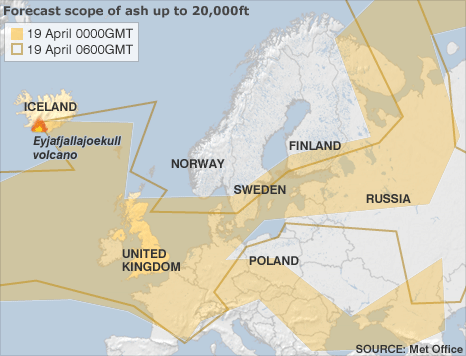
The bodies representing most European airlines and airports have questioned the need for the unprecedented curbs, which affect millions of travellers.
Airlines that have carried out test flights say planes showed no obvious damage after flying through the ash.
EU Transport Commissioner Siim Kallas said he hoped 50% of Europe's airspace would be risk-free on Monday.
He said the current situation was "not sustainable" and European authorities were working to find a solution that did not compromise safety.
Mr Kallas also said EU transport ministers would hold a video teleconference on Monday to assess the situation. About 17 European countries have closed their airspace.
The flight bans came amid fears that the ash - a mixture of glass, sand and rock particles - can seriously damage aircraft engines. Airlines are estimated to be losing some £130m ($200m) a day.
ACI Europe - which represents major airports - and the Association of European Airlines issued a joint statement urging officials to reconsider the restrictions.
'Dangerous levels of ash'
"The eruption of the Icelandic volcano is not an unprecedented event and the procedures applied in other parts of the world for volcanic eruptions do not appear to require the kind of restrictions that are presently being imposed in Europe," the statement said.
Earlier, several airlines also questioned the curbs.
Peter Hartman, chief executive of Dutch carrier KLM, said there had been "nothing unusual" about a test flight carried out by the airline through the plume, and he hoped to "get permission as soon as possible to partially restart our operations".
Steven Verhagen, vice-president of the Dutch Airline Pilots Association, told the Associated Press news agency: "In our opinion there is absolutely no reason to worry about resuming flights."
Germany's two biggest airlines, Lufthansa and Air Berlin, also said they had carried out test flights without apparent damage, as did Air France.
Air Berlin spokeswoman Diana Daedelow told the BBC: "It is astonishing that these findings... have seemingly been ignored in the decision-making process of the aviation safety authorities."
A British Airways Boeing 747 completed a test flight through the no-fly zone at 30,000ft (9.1km) from Heathrow to Cardiff on Sunday.
While it encountered no problems, no loss of engine performance and no damage to windows, engineers in Cardiff were due to make a more detailed assessment of its engine overnight.
Earlier on Sunday, a UK Met Office plane went through the cloud and encountered dangerous levels of ash, showing that the issue is not whether the cloud is real and dangerous but whether its extent can be accurately mapped, BBC business editor Robert Peston writes.
One possible solution is to put observation planes in the sky, to give a more detailed picture of the location of ash concentrations, and the UK government is therefore trying to obtain more observation planes, from the military in particular, he adds.
Our business editor understands that BA fears it may not be allowed to fly normal services until Thursday at the earliest.
Worsening disruption
UK Transport Secretary Lord Adonis, said "urgent discussions" were taking place between European and international agencies to ease the chaos.
"We want to be able to resume flights as soon as possible, but safety remains my paramount concern," he said.
Weather experts say wind patterns mean the cloud is not likely to move far until later in the week.
Brian Flynn, head of operations at Eurocontrol - which co-ordinates air traffic control in 38 nations - dismissed suggestions the authorities were being over-cautious.
"With the overriding objective of protecting the travelling public, these exceptional measures have to be taken," he said.
Eurocontrol said there were only 5,000 flights in European airspace on Sunday, against 24,000 normally. There was a similar figure on Saturday. All but 55 of 337 scheduled flights by US carriers to and from Europe were also cancelled.
EU Says Half of Normal Flights May Operate Monday
Sunday, April 18, 2010

The European Union presidency says it hopes some air traffic will resume Monday, easing the near-complete disruption of flights caused by volcanic ash from Iceland. The Spanish secretary of state for EU affairs, Diego Lopez Garrido, says weather forecasters predict skies will clear over parts of Europe Monday, allowing about 50 percent of flights to operate.
But Britain, Germany, and the Netherlands say their airspace will remain closed much of the day. A volcano in southeastern Iceland erupted Wednesday, sending a thick cloud of ash and dust into the air that cancelled most trans-Atlantic and European flights.
Volcanic ash contains glass and rocks that could cause jet engines to shut down in mid- flight. Major European airlines, including KLM, Lufthansa, and Air France, conducted test flights with no passengers Saturday and Sunday and reported no problems.
But meteorologists warned that unpredictable wind shifts were still making air travel too dangerous Sunday. Industry analysts say the airlines are losing about $200 million a day because of the canceled flights, which are also snarling plans for U.S. and Asian travelers.
Air Berlin chief Joachim Hunold criticized the airline shutdowns. He says the decisions were based only on computer models that show how much ash may be in the air.
German media quoted him Sunday as saying that no one has sent up weather balloons to take actual readings.
Disrupted Air Travel in Northern Europe for Third Full Day
Sunday, April 18, 2010

Iceland's volcano erupted Wednesday and has since been spewing ash several miles into the air. The ash clouds include particles of rock, glass and sand that can get into an aircraft's engine and cause it to stall.Northern European skies were clear of most commercial planes Saturday. The European air traffic agency said Iceland's volcanic eruption, which began on Wednesday, will continue to impact European aviation until at least Sunday morning. Thick clouds of ash continue to blow across the continent. Hundreds of thousands of passengers around the world remain stranded for a third day as European flights were slashed Saturday down to one-quarter of their normal number. The shutdowns are expected to continue for at least another several days. People have crowded onto trains, buses and ferries in a bid to carry out their travel plans - and cab companies say they are being paid thousands of dollars to ferry people across Europe by car. The European air traffic control agency Eurocontrol said only 6,000 flights would take place in European airspace Saturday - down from the 22,000 normally expected. On Friday, Eurocontrol said about 16,000 or Europe's usual 28,000 daily flights were canceled. Airspace in northern France was closed until Monday morning. Southern Europe, including Spain, southern Italy, Greece, and Turkey remains open for flights. Martin Crozier, senior meteorological officer at the Guernsey Met Office in England, says the volcanic eruption in southeast Iceland that has sent European aviation into meltdown is showing no sign of easing up. "The situation hasn't improved at all I'm afraid," he said. "The volcano over Iceland is still producing quite a lot of ash. The upper level winds are still transporting that down towards the U.K. and northwest Europe. So if anything we have a reinforcement of the ash that's already up there - so things aren't looking too good today I'm afraid."
Crozier says the wind patterns that are pushing the volcanic dust towards Europe are expected to persist for days to come. "I think we're going to get the upper level winds carrying that ash down for a few more days yet until the upper wind patterns change which will probably not happen until the time frame Thursday-Saturday. So really at a worst-case scenario, with the volcano still going strongly, we could get airspace affected for the next few days," he said.
Iceland's volcano erupted Wednesday and has since been spewing ash several miles into the air. The ash clouds include particles of rock, glass and sand that can get into an aircraft's engine and cause it to stall.
The International Air Transport Association said Friday that the airline industry is losing more than $200 million in revenue a day - and they called this a conservative estimate.
Crozier says European aviation has never seen anything like it. "In terms of disruption to aviation I think this is probably the worst it's been in northwest Europe," he said.
The last major disruption to European aviation followed the September 11 attacks in the United States almost a decade ago. U.S. airspace was closed for three days and European airlines cancelled all transatlantic flights.
The World Health Organization has warned people with breathing problems to remain indoors as much as possible when the ash is falling.
Airspace was closed Saturday in at least parts of more than a dozen countries - in some countries, the skies were emptied of commercial flights.
European Ash Cloud Continues to Spread, Halting Flights for Second Day
Saturday, April 17, 2010

A huge cloud of volcanic ash from Iceland has disrupted air travel across Europe for a second day, as stranded passengers face the most extensive shutdown of airspace since the September 11, 2001 terrorist attacks.
The skies above large parts of Europe were empty for a second day Friday, as air safety authorities warned that the cloud of ash from Iceland's volcano is spreading.
Brian Flynn, head of operations at the European air traffic control body, addressed a press conference in Brussels.
"Today the situation has deteriorated somewhat," he said. "We would be expecting 29,500 flights today. We think we will only have about 12- or 13,000 flights able to operate. So effectively we will be losing more than 50 percent of the normal passenger movements in Europe today."
Civilian aircrafts are right now not flying in Britain, Belgium, the Netherlands, Denmark, Sweden, Norway, Finland, Estonia, the north of France including all Paris airports, northern parts of Germany, parts of Poland including Warsaw airport and the Czech Republic.
And Flynn says the cloud is spreading. "The southern part of Europe is for the most part clear but the volcanic ash cloud is anticipated to extend slightly further south and eastward during this night," he said.
A huge cloud of volcanic ash from Iceland has disrupted air travel across Europe for a second day, as stranded passengers face the most extensive shutdown of airspace since the September 11, 2001 terrorist attacks.
The skies above large parts of Europe were empty for a second day Friday, as air safety authorities warned that the cloud of ash from Iceland's volcano is spreading.
Brian Flynn, head of operations at the European air traffic control body, addressed a press conference in Brussels.
"Today the situation has deteriorated somewhat," he said. "We would be expecting 29,500 flights today. We think we will only have about 12- or 13,000 flights able to operate. So effectively we will be losing more than 50 percent of the normal passenger movements in Europe today."
Civilian aircrafts are right now not flying in Britain, Belgium, the Netherlands, Denmark, Sweden, Norway, Finland, Estonia, the north of France including all Paris airports, northern parts of Germany, parts of Poland including Warsaw airport and the Czech Republic.
And Flynn says the cloud is spreading. "The southern part of Europe is for the most part clear but the volcanic ash cloud is anticipated to extend slightly further south and eastward during this night," he said.
The volcano on a glacier in Iceland erupted Wednesday.
The volcano has sent a massive cloud of microscopic ash particles swirling across northern Europe - particles that air specialists say are highly abrasive and could cause aircraft engines to fail.
They could also be bad for people's health, the World Health Organization said Friday.
Spokesperson David Epstein says the ash, which is drifting at an altitude of almost 10 kilometers, could be harmful when it hits the ground.
"These are the same kind of fine matter found in normal air pollution. These can be sulfate, nitrate, ammonia, sodium chloride and if these are small particles they can be dangerous because if they are inhaled they can reach the lungs."
Epstein says when the ash does settle people should remain indoors as much as possible. The United Kingdom Health Protection Agency warned that the ash could cause itchy eyes, a runny nose, sore throat or dry cough.
Colin Macpherson, a professor of Earth sciences at Britain's Durham University, says it's impossible to know how long the volcano will continue to erupt. The last time this volcano did erupt in the early 19th century, he says, it lasted two years.
"Some volcanic eruptions last for just a few days. Others last for months or even years. There is no clear way of predicting at the present time how long this activity might go on for," he said.
But he says, it's because of current wind patterns that the volcano is having such a major affect on European air travel. "It's because we have the prevailing wind at the moment coming from the north, pulling the material down towards Western Europe that we're seeing the impact on the travel of so many people," said Macpherson.
In the spring and summer, he says, he would expect the prevailing winds in Western Europe to come from the West or Southwest - which would mean that the ash would be pushed towards the Arctic or Siberia.
Icelandic Volcano Impacts Economy, Industry, Environment
Saturday, April 17, 2010
Millions of passengers have been stranded after a huge ash cloud spread from an Icelandic volcano toward Europe since Wednesday, April 14. Volcanic ash presents a particular challenge not only to airline passengers, but also to the travel industry, and the countries affected by the plume.
Air traffic controllers in Europe canceled more than 16,000 flights Friday because of the huge plume of ash from the Eyjafjallajokull volcano. The cloud drifted toward Europe and is predicted to cover as far north as northern Italy, Britain, the Scandinavian countries, Romania, Hungary, Slovenia, Croatia, and Switzerland.
The canceled flights are costing the airlines an estimated $200 million per day, and passengers are stranded at major airports including Frankfurt, London, and Rome.
Bill Miller is a Senior Vice President with CheapOair travel company, and he told VOA that the $200 million is a conservative estimate and the impact could be felt industry wide.
"Certainly at Heathrow British Airways has a very large presence, as do a lot of North-American based carriers. And in Frankfurt you've got Lufthansa that has a massive operation there. Europe is unique in that they have a lot of low-cost carriers. You've got Easy Jet operating out of Luton airport in London. Some other low-cost carriers throughout Europe. You know, there's like 30,000 flights a day in Europe and I believe about half of them have been canceled as of today," he said.
The ash cloud even trapped Norwegian Prime Minister Jens Stoltenberg, who was stuck in New York after his flight home was canceled. Mr. Stoltenberg used his Apple iPad electronic device to run his government while he made his way home.
The difficulty with volcanic ash is that it is more like small particles of glass rather than the ash left over from a fire. The pumice and other minerals can severely damage aircraft engines, control surfaces and navigation equipment.
Bill Burton is a geologist with the U.S. Geological Survey based outside Washington. He told VOA that volcanic ash is uniquely destructive to aircraft. "It's like sandblasting your aircraft if you fly in the middle of it. So millions of tiny hard pieces are flying into your jet engine. And they are abrading the engine and any forward facing surfaces including windshields. The silica in the ash can also melt and then re-solidify within the engine so you can actually coat the parts of your jet engine. And all of those things can be disastrous," he said.
In 1989, a KLM airlines 747 with 231 passengers aboard lost power to all four of its engines after flying through an ash cloud from the Redoubt Volcano in Alaska. The plane plunged from 27,000 to 13,000 feet before the pilots were able to re-start the engines and finish the flight to Anchorage Alaska.
And volcanic ash also can be toxic to humans, animals and plant life - not only from inhaling the particulates, but as Bill Burton said, from acid rain caused by the sulfur in the ash. "One of the main constituents of the (volcanic) gases is sulfur. And that comes out and oxidizes into sulfur dioxide and that combines with water to form sulfuric acid droplets. And those droplets can then be the source of acid rain. They also can block the sunlight to contribute to climate change, climate cooling in this case," he said.
The Volcanic Ash Advisory Center in London says that the high atmospheric pressure over the Atlantic is dictating that the wind strengths and the cloud will stay in northern Europe. However, should the pressure change, the cloud could move more toward the Mediterranean.
Bill Miller of CheapOair says that many airlines are keeping travelers informed. But he said travelers need to be patient. "It's a volcano, so nobody can really accurately predict what is going to happen. How long it is going to take. There are some airports that are already shut down all the way through Monday (April, 19). So I think the traveling public needs to make sure that they are aware of what communications channels to stay tuned into," he said.
Miller told VOA that some insurers are covering the tickets for canceled flights. And while airlines are losing millions of dollars to lost tickets, Miller said they are also not spending money for fuel, flight crews, and other expenses. While that is small comfort for stranded travelers, for now, there is nothing to do but wait.
Volcanic Ash Cloud Continues to Halt Flights Across Europe
Saturday, April 17, 2010

A huge cloud of volcanic ash from Iceland has disrupted air travel across Europe for a second day, as stranded passengers face the most extensive shutdown of airspace since the September 11, 2001 terrorist attacks. The European air traffic conrol agency, Eurocontrol, said about 17,000 flights are likely to be canceled Friday and authorities say the disruptions will continue into Saturday. Officials say about half of the daily flights between Europe and North America would be cancelled Friday. Many flights between Asia and Europe were also affected. It is not clear how the ash cloud will affect the arrival of world leaders planning to attend the state funeral Sunday of Polish President Lech Kaczynski. The funeral is to be held in Krakow, in southeastern Poland. Polish officials have closed the airspace in the northern part of the country. Major European airports were shut down Thursday, leaving tens of thousands of passengers from the United States, Europe, and Asia stranded. Several northern European countries - including Britain, Norway, Sweden, and Denmark - had completely closed their airspace. Wednesday's eruption in southeastern Iceland melted part of a huge glacier, causing floods that forced hundreds of residents to flee their homes. The volcano sent ash and debris about eight kilometers into the sky. In addition to reducing visibility, aviation authorities say volcanic ash contains small particles of glass that can cause jet engines to shut down in midflight. They say airplanes struck by volcanic debris have in some cases plummeted thousands of meters before pilots were able to restart the engines. The Icelandic volcano has erupted twice since March 20. It had been dormant for nearly 200 years. Geologists say volcanoes are notoriously unpredictable.
Icelandic Volcano Impacts Economy, Industry, Environment
Saturday, April 17, 2010
Millions of passengers have been stranded after a huge ash cloud spread from an Icelandic volcano toward Europe since Wednesday, April 14. Volcanic ash presents a particular challenge not only to airline passengers, but also to the travel industry, and the countries affected by the plume.
Air traffic controllers in Europe canceled more than 16,000 flights Friday because of the huge plume of ash from the Eyjafjallajokull volcano. The cloud drifted toward Europe and is predicted to cover as far north as northern Italy, Britain, the Scandinavian countries, Romania, Hungary, Slovenia, Croatia, and Switzerland.
The canceled flights are costing the airlines an estimated $200 million per day, and passengers are stranded at major airports including Frankfurt, London, and Rome.
Bill Miller is a Senior Vice President with CheapOair travel company, and he told VOA that the $200 million is a conservative estimate and the impact could be felt industry wide.
"Certainly at Heathrow British Airways has a very large presence, as do a lot of North-American based carriers. And in Frankfurt you've got Lufthansa that has a massive operation there. Europe is unique in that they have a lot of low-cost carriers. You've got Easy Jet operating out of Luton airport in London. Some other low-cost carriers throughout Europe. You know, there's like 30,000 flights a day in Europe and I believe about half of them have been canceled as of today," he said.
The ash cloud even trapped Norwegian Prime Minister Jens Stoltenberg, who was stuck in New York after his flight home was canceled. Mr. Stoltenberg used his Apple iPad electronic device to run his government while he made his way home.
The difficulty with volcanic ash is that it is more like small particles of glass rather than the ash left over from a fire. The pumice and other minerals can severely damage aircraft engines, control surfaces and navigation equipment.
Bill Burton is a geologist with the U.S. Geological Survey based outside Washington. He told VOA that volcanic ash is uniquely destructive to aircraft. "It's like sandblasting your aircraft if you fly in the middle of it. So millions of tiny hard pieces are flying into your jet engine. And they are abrading the engine and any forward facing surfaces including windshields. The silica in the ash can also melt and then re-solidify within the engine so you can actually coat the parts of your jet engine. And all of those things can be disastrous," he said.
In 1989, a KLM airlines 747 with 231 passengers aboard lost power to all four of its engines after flying through an ash cloud from the Redoubt Volcano in Alaska. The plane plunged from 27,000 to 13,000 feet before the pilots were able to re-start the engines and finish the flight to Anchorage Alaska.
And volcanic ash also can be toxic to humans, animals and plant life - not only from inhaling the particulates, but as Bill Burton said, from acid rain caused by the sulfur in the ash. "One of the main constituents of the (volcanic) gases is sulfur. And that comes out and oxidizes into sulfur dioxide and that combines with water to form sulfuric acid droplets. And those droplets can then be the source of acid rain. They also can block the sunlight to contribute to climate change, climate cooling in this case," he said.
The Volcanic Ash Advisory Center in London says that the high atmospheric pressure over the Atlantic is dictating that the wind strengths and the cloud will stay in northern Europe. However, should the pressure change, the cloud could move more toward the Mediterranean.
Bill Miller of CheapOair says that many airlines are keeping travelers informed. But he said travelers need to be patient. "It's a volcano, so nobody can really accurately predict what is going to happen. How long it is going to take. There are some airports that are already shut down all the way through Monday (April, 19). So I think the traveling public needs to make sure that they are aware of what communications channels to stay tuned into," he said.
Miller told VOA that some insurers are covering the tickets for canceled flights. And while airlines are losing millions of dollars to lost tickets, Miller said they are also not spending money for fuel, flight crews, and other expenses. While that is small comfort for stranded travelers, for now, there is nothing to do but wait.